
CaliClaims Law
one call. that's all
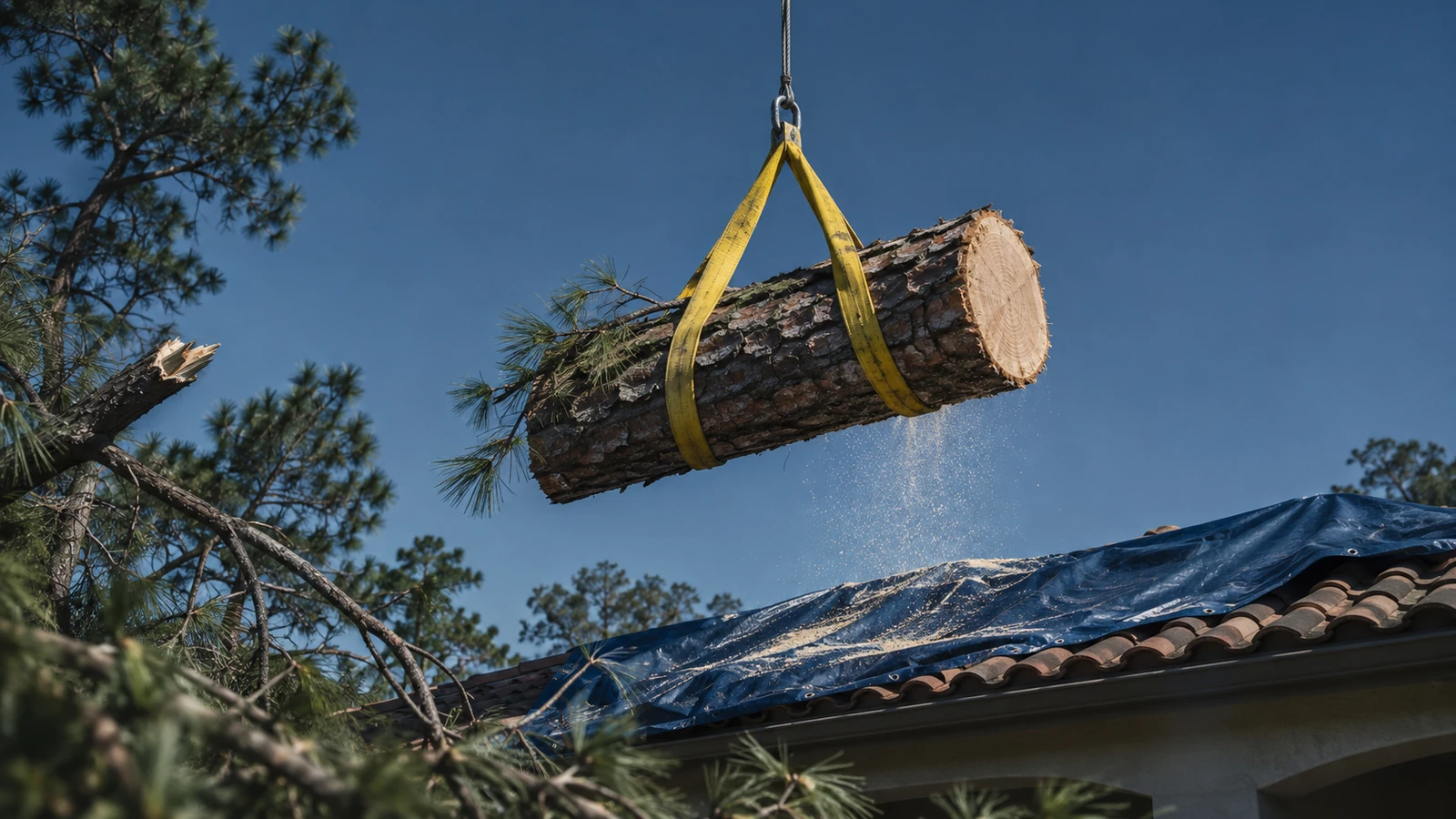
Santa Ana season turns trees into projectiles. Shallow-rooted eucalyptus, drought-stressed pines, and overgrown ficus come down across Southern California every autumn, onto roofs, garages, cars, fences, and service lines, and the first question at the curb is always the same. Whose insurance pays for this?
The answer depends on what the tree hit, what made it fall, and whose tree it was, in roughly that order of importance. Policyholders tend to fix on the last question, the neighbor whose tree it was, when the policy is built almost entirely around the first two.
This article covers when tree damage is covered, how tree and debris removal work, whose policy pays when a tree crosses a property line, and the disputes carriers raise. Coverage always depends on the specific policy language and the facts of the loss.
Start with what the tree hit. The dwelling and the other structures on the lot are insured against direct physical loss unless an exclusion applies, and a windstorm, a falling object, and the weight of a fallen tree are ordinary covered causes. A tree through the roof is a roof and interior claim. A tree across the fence, the shed, or the detached garage is an other structures claim, which carries its own limit that is often a fraction of the dwelling limit. A tree on the car is an auto claim under comprehensive coverage, not a homeowners claim at all.
The tree itself is a different matter. Standard policies cover trees, shrubs, and plants under a small sublimit and only for a short list of named perils: fire, lightning, explosion, vandalism, theft, and a few others. Wind is not on that list. So a mature tree that a windstorm destroyed is not a covered loss as a tree, while the same tree lost to a fire is, up to the sublimit. That distinction surprises nearly everyone the first time they hear it.
Tree removal is its own additional coverage, and its trigger is what the tree did rather than why it fell. Most forms pay to remove a fallen tree when it damaged a covered structure, or when it blocks a driveway or a ramp needed for access, subject to a per-occurrence sublimit that is modest by any Southern California standard. A tree that came down in the yard and hit nothing is generally not covered for removal at all. Some forms are broader, paying removal whenever a covered peril felled the tree, and the policy language is the only way to know which form is in force.
Debris removal rounds out the coverages. It pays to remove the debris of covered property, the broken roof tile and shattered fence boards, usually as an additional amount above the limits, while the tree debris runs through the tree removal sublimit. Which pile of debris falls under which coverage is worth sorting out on the invoice, because the answer changes what gets paid.
Your damage is your claim. When a neighbor's tree falls on your house, your own policy pays for the repair, and it does so regardless of who owned the tree. The neighbor's carrier will not step in simply because the tree was theirs. A healthy tree brought down by a wind event is, in the law's eyes, nobody's fault, and a first-party claim is the only claim there is.
Negligence changes that. If the tree was visibly dead or diseased, if the neighbor had been told about it in writing, or if a prior inspection or a city notice flagged it, the neighbor may be responsible for failing to take reasonable care of it. That claim runs against the neighbor's liability coverage, and it can proceed alongside your own claim rather than instead of it. In practice your carrier pays your loss first and pursues the neighbor's carrier afterward for reimbursement, and the third-party article on this site walks through how those claims work.
The same rules run in reverse. When your tree lands on the neighbor's roof, their policy pays their repair, and your liability coverage responds only if the neighbor can show you neglected a tree you knew was a hazard. Notify your carrier anyway, because liability coverage includes the handling of the claim, and because a neighbor's demand letter is something the carrier should see early.
City trees are a separate world. Parkway trees between the sidewalk and the street are often owned and maintained by the city, and a claim for damage a city tree caused runs through a government claims process with its own written claim requirements and short deadlines that bear no relation to a homeowners policy. Your own carrier still pays your repair in the meantime. Shared trees on the property line belong to both owners, which usually means both policies and a careful set of photographs.
The region's trees fail in characteristic ways. Eucalyptus sheds large limbs and can uproot in wind. Pines stressed by drought and beetles snap. Ficus roots lift hardscape and sewer lines for years before the tree itself comes down. Palms drop crowns and fronds heavy enough to break tile. Each failure mode leaves evidence at the break, and the evidence matters, because a carrier that finds rot in the failure point will argue decay rather than wind caused the loss. California's rule for losses with more than one cause, discussed in the roof article on this site, is the answer to that argument.
Hillside lots raise a harder version of the same question. A tree that came down with a slope after a storm brings the earth movement exclusion into play, and whether the wind, the saturated soil, or the movement of the slope was the predominant cause becomes the entire claim. Root damage to foundations and drain lines is generally treated as gradual and excluded, though a sudden collapse of a line can present differently.
Cost is where the sublimits show their age. Removing a large tree from a roof in a dense neighborhood means a crane, a crew, a street permit, and a landfill run, and cities that protect certain species may require a removal permit as well. Those costs routinely exceed the tree removal sublimit several times over. The distinction that protects the policyholder is between removing the tree from the structure, which is part of repairing the structure, and hauling the rest of it away, which is what the sublimit was written for. Carriers prefer to put the whole invoice under the sublimit, and an itemized invoice is what prevents it.
Six steps that keep a fallen tree claim from being settled at the sublimit.
Storm and wind claims are commonly reduced by attributing damage to age or maintenance rather than the weather event. That call can determine what gets paid. Send the adjuster's report, the estimate, or the denial letter, and we review your policy alongside the insurer's reasoning. Nothing is owed upfront.
Get my free claim reviewCalifornia holds tree owners to a standard of reasonable care rather than strict liability. An owner who knew, or should have known, that a tree was dead, diseased, or otherwise hazardous and did nothing can be responsible when it falls. An owner whose healthy tree came down in a wind event is not. Notice is the hinge, which is why written complaints, prior inspection reports, and city notices are the evidence a negligence claim is built on, and why a neighbor who ignores a warning letter has changed their position considerably.
Cause disputes with the carrier are governed by the efficient proximate cause rule. When wind, decay, saturated soil, or earth movement combine to bring a tree down, coverage depends on which cause predominated and set the others in motion. A carrier cannot simply point to rot in the break and declare the loss excluded; it has to investigate the cause, and a denial has to state the specific policy provisions and facts relied on under California's fair claims settlement regulations. Those regulations also require the carrier to explain which coverage and which sublimit it applied to each cost, an explanation that is easier to demand when the invoice is itemized.
Claims involving public entities follow a different statute. California requires a written claim to be presented to the city or county within a strict period before any lawsuit can be filed, and the period is short enough that a policyholder who waits for the homeowners claim to resolve first can lose the right entirely. The period is not stated here because it should be confirmed for the specific entity and facts, but the point stands: a city tree means two clocks, and the second one runs faster.
The firm separates the structure repair from the tree work at the outset, because that is where most of the money moves. Lifting the tree off the house is priced as part of restoring the house; hauling it away is measured against the sublimit; and each item the tree damaged is assigned to the dwelling or other structures limit with the policy language beside it.
Cause is documented with the failure point, the weather record, and the mixed-cause rule where a carrier reaches for decay or earth movement. Where a neighbor's negligence is real, the facts go to the carrier for reimbursement and, when warranted, into a third-party claim. Everything is done for the policyholder alone, in writing.
Past results do not guarantee a similar outcome. Every claim is different.
Your own policy pays for your roof, and it does so regardless of who owned the tree. The neighbor's insurance becomes involved only if the neighbor was negligent, for instance by ignoring a tree that was visibly dead or that they had been warned about. File your own claim first and give your carrier the facts about the tree's condition.
On most forms, no, unless the tree blocks a driveway or a ramp needed for access. Some broader forms pay removal whenever a covered peril felled the tree, so read the tree removal provision before assuming. The tree's own value is not covered for wind on a standard policy either.
Not for wind. Trees, shrubs, and plants are covered under a small sublimit and only for named perils such as fire, lightning, and vandalism. If a fire destroyed the landscaping, the sublimit applies and the trees are part of the claim. If a windstorm did, they are not.
Usually not. Lifting the tree off the structure so the roof can be repaired is part of the covered repair, and only the cutting, hauling, and disposal belong under the sublimit. Ask the tree service for an itemized invoice that separates the two and resubmit with the policy's repair provisions cited.
Send the photographs, the tree service invoice, the carrier's estimate, and the declarations page. The firm checks which limit each item belongs under, whether the sublimits were applied correctly, and whether the facts support a claim against a neighbor or a public entity. CaliClaims Law reviews property insurance claims for Southern California policyholders at no cost. One call. That's all.