
CaliClaims Law
one call. that's all
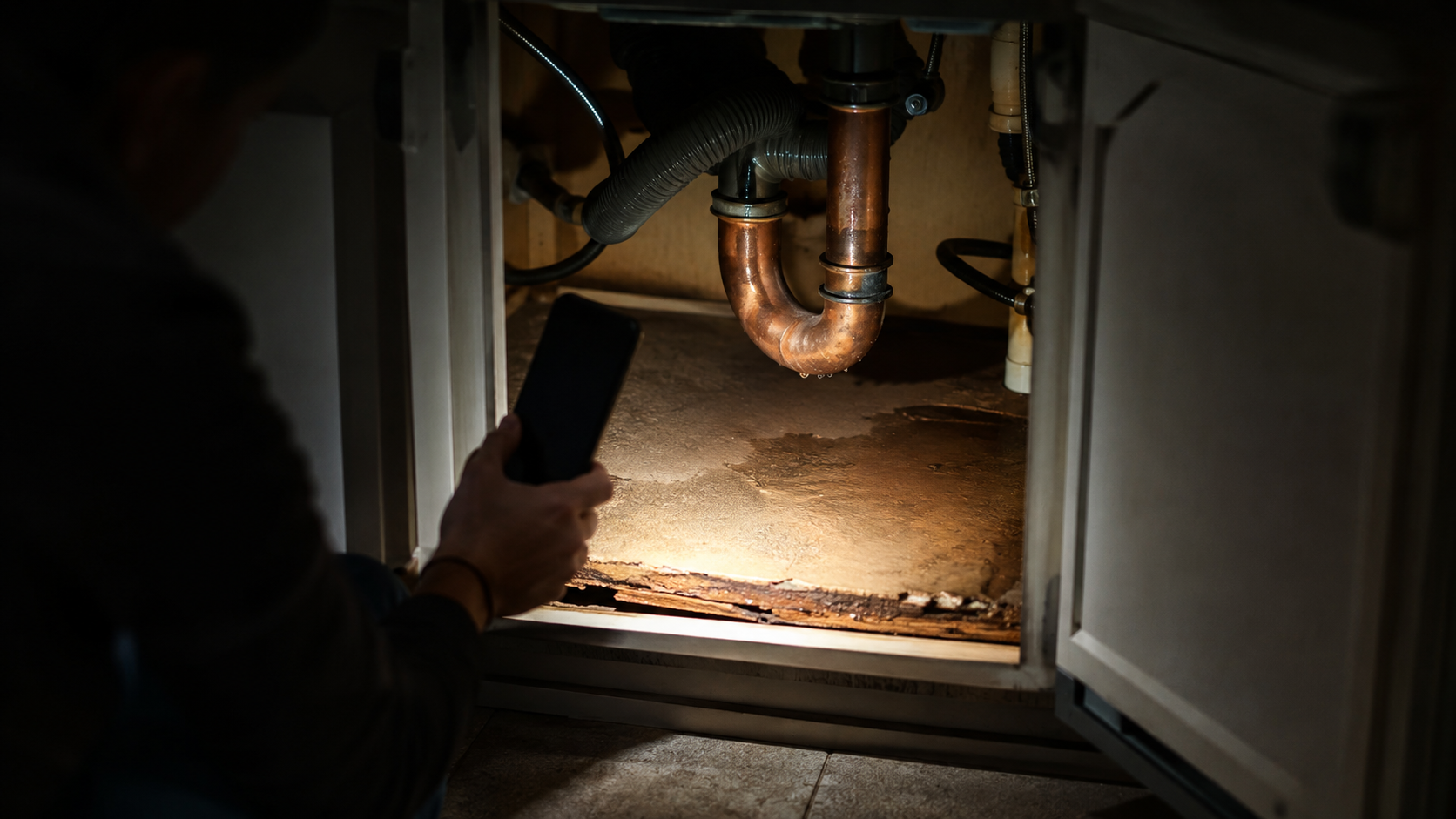
Water is the claim most Southern California homeowners will actually file. Fires make the news, but supply lines burst, water heaters let go, washing machine hoses split, and showers leak into the framing below, in every city and in every season.
Whether the policy responds depends less on how bad the damage is than on how the water got out. A pipe that fails at once is a claim. The same pipe weeping for a year is usually an exclusion. That single distinction, sudden and accidental against gradual, drives most of the arguments between California homeowners and their carriers.
This article maps the coverage, the fights, and the sequence to follow the day you find the damage. Coverage always depends on the specific policy language and the facts of the loss.
Standard California homeowners policies cover direct physical loss from the accidental discharge or overflow of water from plumbing, appliances, and similar systems. They exclude damage from constant or repeated seepage over time, from deterioration and deferred maintenance, and, under a separate exclusion, from flood and surface water, which is a distinct insurance product altogether.
The categories sound clean and the facts never are. A slow leak can end in a sudden rupture. Damage discovered today may have accumulated invisibly inside a wall for months through no fault of anyone. Carriers read ambiguity toward the excluded side, describing losses as long term whenever staining, corrosion, or microbial growth gives them a foothold, because the excluded description is the cheaper one.
Two features of the typical policy cut back the other way. The ensuing loss concept means that even where the failed component or its slow deterioration is excluded, the resulting water damage from a covered discharge frequently is not. And exclusions are construed narrowly under California law, with the insurer bearing the burden of proving one applies. A claim that gets denied in a sentence often deserved a paragraph of analysis.
Endorsements move the line as well. Water backup coverage adds sewer and drain backup losses the base form excludes. Limited water damage endorsements on some newer policies cap what was once fully covered. Service line coverage reaches failures in buried pipes outside the foundation. The answer to whether this policy covers this water is assembled from the declarations page and every endorsement on it, which is why the certified complete policy, not the renewal summary, is the document that decides.
Causation timing is the main event, and it is an evidence contest. Moisture readings, the condition of the failed part, plumber findings, and photographs of the water path all bear on whether the discharge was sudden. The homeowner controls most of that evidence in the first days, and loses control of it as drying, demolition, and disposal proceed.
Water category drives remediation scope more than most policyholders realize. Clean supply line water, gray water from appliances and drains, and contaminated water from sewage backups each carry different industry protocols, and the dirtier the category, the more material must be removed rather than dried. An estimate that treats a sewage event with a clean water protocol is underscoped by definition, so establish the category early, get it stated in the mitigation records, and hold the estimate to the protocol the category requires.
Scope is the second front. Water travels, and proper remediation follows it into base plates, insulation, and adjacent rooms, with drying standards and moisture mapping to verify the result. Carrier estimates habitually stop at the visibly wet, and the difference between drying a wall and drying the visible half of a wall shows up later as mold, covered in a separate article in this series.
Then come the classification fights: whether tear out of the slab or wall to reach the broken pipe is covered even when the pipe is not, how mold sublimits interact with the water loss that caused the mold, and whether the event was plumbing discharge or excluded surface water. Each is a policy language question, and each is answered by the specific form, not by the adjuster's summary of it.
Vendor selection is a quieter lever. Carriers steer losses toward preferred mitigation networks, and those firms can do fine work, but the policyholder generally chooses who works on the home, and the choice matters when the preferred vendor's scope keeps matching the carrier's budget instead of the moisture map. Whoever does the work, require a written scope before demolition, daily drying logs, and final readings, because those records serve the claim long after the equipment leaves.
Water claims often turn on a single question: whether the loss happened suddenly or developed over time. That distinction can decide coverage, and it is frequently resolved against the policyholder with little explanation. Send us what you have. We read the policy language the insurer is relying on and tell you how it applies. Reviews cost nothing.
Get my free claim reviewReal losses mix causes, some covered and some excluded, and California resolves the mixture with the efficient proximate cause doctrine: coverage generally follows the predominant cause that set the loss in motion. When a covered discharge is the driving cause, an excluded contributor in the chain does not automatically defeat the claim, and policy wording that tries to say otherwise does not always hold up under California law.
This doctrine matters because denial letters often work by relabeling. The loss gets described by its excluded ingredient, deterioration, seepage, or ground water, while the covered event that predominated goes unmentioned. Framing the claim around the true driving cause, with the evidence arranged behind it, is frequently the whole ballgame.
Burden allocation quietly favors the prepared policyholder. Showing a covered discharge occurred and damage followed is the insured's job, and it is usually the easy half. Proving that an exclusion applies is the carrier's, and California reads those exclusions narrowly. An adjuster's impression that the damage looks old is not proof of anything, and a written response that separates the two burdens, here is our showing, where is yours, reframes the file in a way casual phone advocacy never does.
Water disputes are won on causation records, so the firm's first pass is an evidence audit: what exists on the source, the timeline, the moisture mapping, and the drying, and what can still be obtained before it disappears. Gaps get filled fast, because this is the claim type where evidence decays by the day.
With the record set, the coverage argument gets written against the policy's actual discharge, seepage, and ensuing loss language rather than the adjuster's paraphrase of it. The firm sits on the policyholder side of these fights only, and the goal is the full water path restored, not the visible corner of it.
Past results do not guarantee a similar outcome. Every claim is different.
Interior water damage is often covered when a storm creates the opening, while the roof itself and leaks attributed to age or wear generally are not. It becomes a causation question about the roof's condition and the weather event, which is exactly the analysis the storm damage article in this series takes up.
Slab leaks bundle several coverage questions at once, including access costs, tear out, and the line between sudden failure and long term seepage. They are common enough in Southern California to get their own article in this series, and they reward early, careful documentation more than almost any other water loss.
Rising surface water and storm runoff are excluded from standard homeowners forms and are insured separately, typically through the federal flood program or private flood policies. The boundary disputes arise when wind driven rain or a plumbing failure gets labeled as flood, and those labels can and should be contested on the facts.
Mold flowing from a covered water loss is frequently compensable, subject to sublimits that vary by policy, and the interaction is contested enough that this series gives it a dedicated article. The immediate move is to keep the water claim and its documentation strong, because the mold analysis rides on it.
Send the policy, the estimate, the plumber's note, and the photos, and you get a straight read on the sudden versus gradual fight and the scope gaps. CaliClaims Law reviews property insurance claims for Southern California policyholders at no cost. One call. That's all.