
CaliClaims Law
one call. that's all
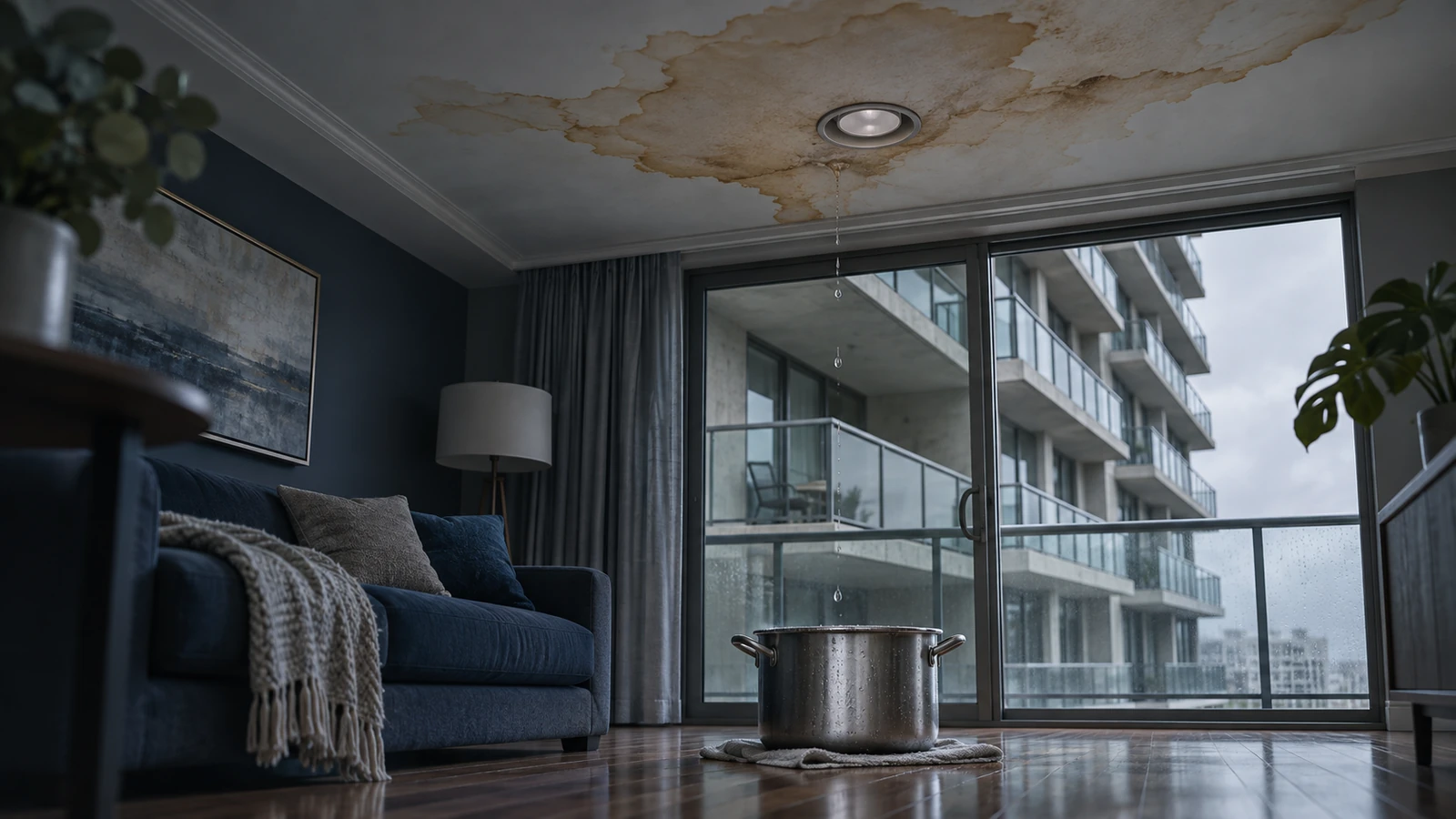
Water comes through the ceiling of a condo, and within a day three parties are pointing at each other: the owner upstairs, the association, and a carrier for each of them. The owner in the unit below has a soaked floor, a stained ceiling, and a question nobody wants to answer first. Whose policy pays?
The answer lives in three documents most owners have never read together: the association's CC&Rs, the master policy, and the owner's own HO-6. Loss assessment coverage sits at the seam between them, and it is the part of a condo policy that goes unnoticed until the association sends a bill.
This article explains how the master policy and the HO-6 divide responsibility, what loss assessment coverage does, who pays when water moves between units, and how California's common interest development law shapes the result. Coverage always depends on the specific policy language and the facts of the loss.
The association's master policy insures the building as a whole: roof, exterior walls, structural elements, hallways, shared plumbing and electrical, and amenities. How far it reaches into the units is the variable. A bare walls form stops at the unit's boundary. A walls-in or single entity form includes fixtures, cabinets, and finishes as originally built. An all-in form adds owner upgrades. The CC&Rs and the master policy's own language say which form the building carries, and owners are entitled to know.
The HO-6 picks up where the master policy stops. Depending on the master form, that means the interior finishes, cabinetry, flooring, and fixtures, plus everything a homeowner would recognize: contents, loss of use if the unit is uninhabitable, personal liability, and loss assessment coverage. The dwelling portion of an HO-6 is frequently underbought because owners assume the building's policy covers more of the unit than it does.
The CC&Rs do a second job that matters as much as the coverage split. They allocate maintenance and repair responsibility between the association, the owner, and the exclusive use common areas such as balconies and patios. Because carriers tend to follow the maintenance map when deciding whose loss a damaged component is, the CC&Rs often settle the coverage question before either policy is opened.
The practical starting point is paperwork. California requires associations to give owners a summary of the association's insurance each year, and owners can request the master policy declarations at any time. Having the master declarations, the CC&Rs, and the HO-6 in one folder before a loss turns a three-way argument into a reading exercise.
When a covered loss to common property costs more than the master policy pays, whether because the loss exceeded the limits or fell inside the master deductible, the association recovers the shortfall from owners through a special assessment. Loss assessment coverage on the HO-6 pays the owner's share of that assessment, up to its limit, provided the underlying loss is of a kind the HO-6 would cover. Fire and water losses to common elements are the typical cases.
Limits are where owners get surprised. The base loss assessment limit on many HO-6 forms is small, endorsements raise it, and a number of forms carry a separate, lower sublimit for the portion of an assessment attributable to the master policy deductible. In buildings where the master carrier has moved to large per-unit water deductibles, the deductible sublimit is the one that gets tested, and it is worth reading before the next renewal.
The coverage does not pay everything an association bills. Assessments for deferred maintenance, reserve contributions, or cosmetic projects are not losses. Assessments tied to perils the HO-6 excludes, such as earth movement, are outside it unless endorsed. Assessments arising from a liability judgment against the association may fall under the liability side of the HO-6 rather than the property side, with its own limit.
Timing and proof round out the picture. Coverage attaches to the date of the underlying loss on most forms, not the date the bill arrives, so a policy change between the two can matter. The claim itself needs the assessment notice, the board's action authorizing it, the master policy claim documents showing what was paid and what was not, and evidence that the underlying event was a covered peril. Associations do not always volunteer those records, and owners are entitled to them.
The owner below starts with their own policy. Damage to your unit and your belongings is a first-party claim on your HO-6 regardless of where the water came from, and waiting for fault to be assigned before filing costs time the policy does not give back. The upstairs owner becomes responsible only through negligence, such as ignoring a known leak or a botched repair, and that claim runs against the neighbor's liability coverage rather than replacing your own claim.
The association enters when the source was a common element: a plumbing stack, a roof, an exterior wall, or a supply line the CC&Rs assign to the association. The recurring dispute is classification. The master carrier calls the failed line part of the unit; the HO-6 carrier calls it common. California's default rule, which the CC&Rs can modify, gives the association the common area and the owner the separate interest and exclusive use areas, and the CC&Rs are read first to see whether they changed that default.
Carriers sort out reimbursement among themselves afterward through subrogation, and the owner should let them. The immediate priorities are drying both units before mold takes hold, documenting the source and the path of the water, and keeping the repair moving under the HO-6 while the classification argument runs. An owner who stops work to wait for the association's answer usually inherits a larger loss and a smaller claim.
Deductibles close the loop. Many CC&Rs allow the association to pass the master deductible to the owner whose unit was the source or the owner whose unit was damaged, and modern water deductibles can exceed the repair cost of a single unit. When that happens, the assessment for the deductible is exactly the bill loss assessment coverage was written to pay, subject to the deductible sublimit discussed above.
Six steps keep a condo water loss from becoming a three-way stalemate.
Water claims often turn on a single question: whether the loss happened suddenly or developed over time. That distinction can decide coverage, and it is frequently resolved against the policyholder with little explanation. Send us what you have. We read the policy language the insurer is relying on and tell you how it applies. Reviews cost nothing.
Get my free claim reviewCalifornia's common interest development statute governs associations and their members, and it supplies the default allocation that carriers lean on. Unless the CC&Rs say otherwise, the association maintains and repairs the common area, and each owner maintains the separate interest and the exclusive use common area attached to it. Most classification fights are resolved by reading the CC&Rs against that default rather than by anything in either insurance policy.
The same law requires the association to distribute a summary of its insurance coverage to members on a regular schedule, which is meant to let owners size their own HO-6, including the loss assessment limit, with real information. It also allows associations to impose emergency assessments for necessary repairs outside the usual approval steps, which is why an assessment notice can follow a serious water or fire loss within weeks and why owners should check the coverage question before paying rather than after.
None of this changes the nature of the HO-6. It is a first-party policy, and the carrier owes the same duty of good faith and follows the same claims regulations that apply to any homeowners claim in California. An HO-6 carrier that delays while pointing at the association is not relieved of its own clocks, and those clocks are covered in a separate article on this site.
The firm reads the CC&Rs before either policy, because the maintenance map usually decides the coverage map. Each damaged component is then assigned to the policy that owes it, the loss is tendered to every carrier with a plausible obligation at once, and the correspondence is kept in writing so that finger-pointing produces a record rather than delay.
Assessments get audited item by item against the master claim documents and the HO-6 limits, and an association that cannot produce the records behind a bill hears that in writing too. The work is done for the unit owner only, never for the association or a carrier.
Past results do not guarantee a similar outcome. Every claim is different.
Often, yes, if the CC&Rs allow the deductible to be allocated to the unit that had the loss. That allocation is precisely what the loss assessment coverage on an HO-6 responds to, subject to its limit and any separate deductible sublimit. Read the CC&Rs provision and your endorsement before paying or disputing.
Start with your own HO-6, which covers your damage regardless of fault. A claim against the neighbor requires showing negligence, and the carriers will pursue reimbursement between themselves afterward. Filing your own claim first protects the repair timeline; the fault question can run alongside it.
Generally not. Earth movement is excluded from a standard HO-6 and the loss assessment coverage follows the same exclusions unless a specific endorsement adds it. Owners in buildings without master earthquake coverage should ask about that endorsement before they need it.
For the future, yes, by endorsement at renewal or mid-term. It will not reach back to a loss that already happened, because coverage attaches to the date of the underlying loss on most forms. Raise it now for the next event and handle the current assessment under the limit that was in force.
Send the CC&Rs, the master policy declarations, your HO-6, the photographs, and any assessment notice. The firm maps each item of damage to the policy that owes it, checks the assessment against your limits, and tells you where the claim stands. CaliClaims Law reviews property insurance claims for Southern California policyholders at no cost. One call. That's all.