
CaliClaims Law
one call. that's all
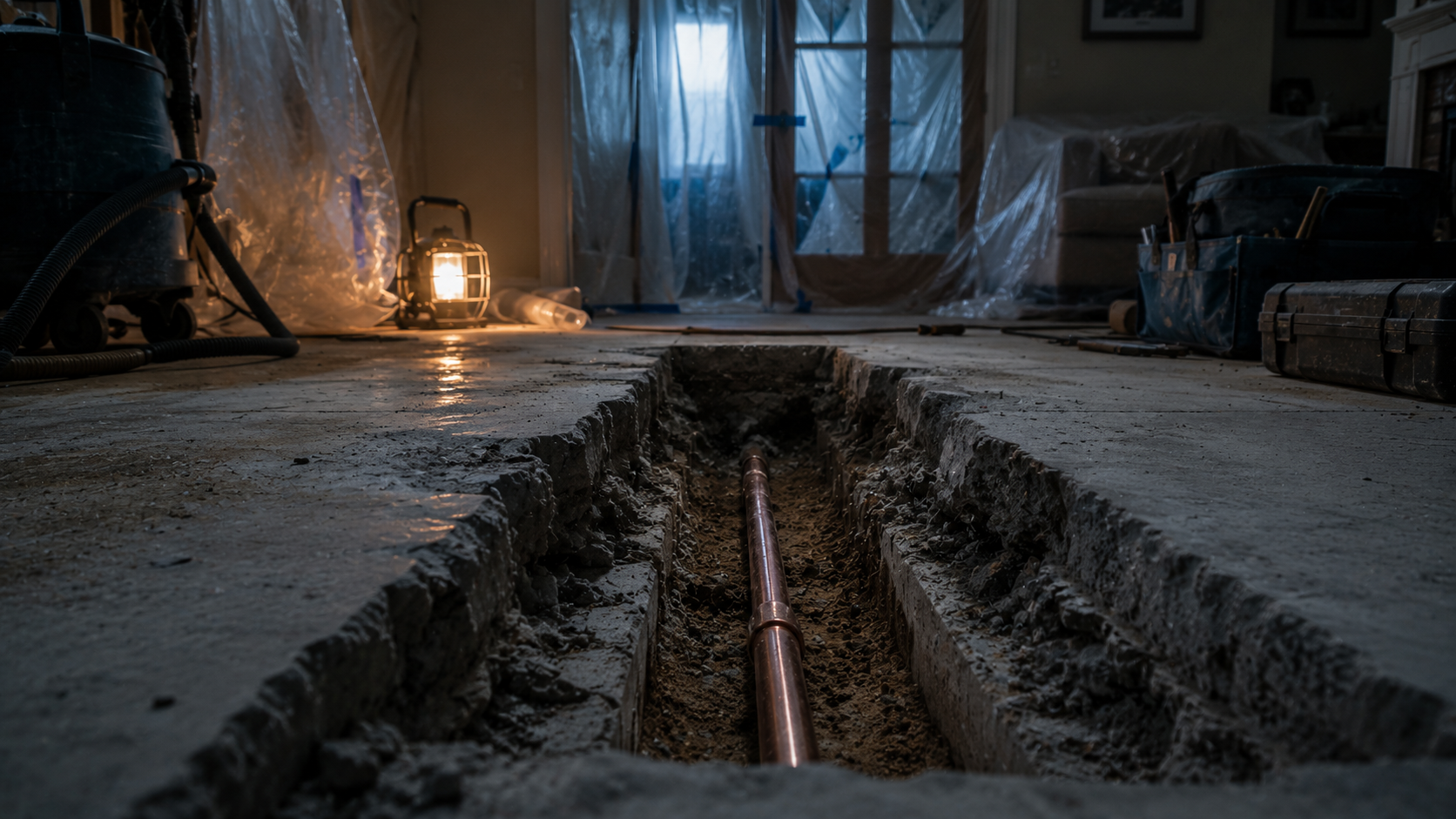
Southern California houses sit on concrete slabs with water lines running beneath or inside them, and those lines age in soil that shifts, in water that corrodes, and in copper that wears thin from the inside. When one fails, the first sign is rarely water. It is a warm spot on the floor, a spinning water meter with everything off, a bill that doubled, or a hairline crack that darkens after every shower.
The insurance claim that follows is more layered than most water losses. There is the pipe, which the carrier will usually call excluded wear and tear. There is the water damage to floors, walls, and framing, which sits under different rules entirely. And there is the expensive middle layer, jackhammering through the slab to reach the failure, that policies commonly treat as covered access cost even when the pipe is not covered. Claims go wrong when those layers get collapsed into a single no.
This article separates the layers and walks through the claim in order. Coverage always depends on the specific policy language and the facts of the loss.
Part one is the pipe. Standard homeowners forms exclude losses caused by wear, deterioration, and corrosion, and a pinhole leak in aging copper fits that description, so the plumbing repair itself is frequently the policyholder's cost. Endorsements change this on some policies, and service line coverage can reach failures outside the foundation, so the answer comes from the declarations page rather than from a rule of thumb.
Part two is the resulting water damage. When water from a plumbing failure damages the home, that discharge is generally a covered peril, and the exclusion that reaches the worn pipe does not automatically reach the wet flooring, the saturated drywall, or the damaged cabinetry. The carrier's ability to deny this layer usually rises or falls on the sudden versus gradual question, whether the escape of water was an event or a long condition.
Part three is access. Policies commonly provide that where a covered water loss requires tearing out and replacing part of the building to reach the source, that tear out is covered, slab demolition included, even while the pipe repair is not. This is the layer adjusters most often leave unmentioned, and it can be the largest number on the claim. Read the policy's own words on tear out before accepting any summary of them.
Water claims often turn on a single question: whether the loss happened suddenly or developed over time. That distinction can decide coverage, and it is frequently resolved against the policyholder with little explanation. Send us what you have. We read the policy language the insurer is relying on and tell you how it applies. Reviews cost nothing.
Get my free claim reviewThe access layer rewards precision. Tear out coverage typically pays to open and restore the part of the building necessary to reach the covered water damage source, which includes breaking and repairing slab, and disputes arise over how much opening was necessary and what restoration standard applies, matching flooring across the room versus patching the trench line. Continuous flooring arguments, covered in the underpayment context elsewhere in this series, apply with full force here.
Rerouting scrambles the categories usefully. When repairing through the slab costs more than abandoning the line and rerouting overhead, the reroute can be the economical path for everyone, and how it gets characterized, repair of covered damage versus plumbing upgrade, affects who pays what share. A written proposal that prices both paths side by side gives the carrier a rational basis to fund the cheaper one, and gives the policyholder a record if it declines and the slab route costs more.
California's general claim rules run underneath all of it: the carrier owes a real investigation, stated bases for what it declines, and narrow readings of its own exclusions. A denial letter that says slab leaks are not covered, full stop, has answered a question the policy splits into three, and that oversimplification is the opening for the challenge.
Expect the carrier's inspection to arrive with its own leak theory, and manage it like the evidence event it is. Be present or represented when the adjuster or the carrier's engineer views the exposed line, make sure they photograph the same failure point your detection report located, and ask for a copy of any consultant report the carrier commissions. Where the carrier's account of the failure differs from your plumber's, that disagreement should surface in writing while the trench is still open, not months later when the slab is patched and the argument is photograph against photograph.
Household records quietly decide the timing fight more often than any inspection does. Water bills across recent cycles establish when usage jumped. A smart meter or leak sensor log, where one exists, timestamps the change to the day. Flooring installation receipts prove the floor now buckling was dry and new at a known date. None of these documents was created for insurance, which is exactly why adjusters find them persuasive, and gathering them in the first week costs an hour that can be worth the whole resulting damage layer.
Slab leak files get triaged into the three layers on day one: what the policy says about the pipe, what the evidence says about sudden versus gradual on the water damage, and what the tear out language promises on access. The demand then prices each layer separately, which is the opposite of how these claims get denied.
Where the carrier has blended the layers or leaned on an unexamined gradual theory, the detection report, the preserved pipe, and the household data go back with the rebuttal. The firm handles these fights for policyholders only, and the measure of success is a restoration that includes the slab, the floors, and the path between them.
Past results do not guarantee a similar outcome. Every claim is different.
Corrosion explains why the pipe failed, not necessarily how the water escaped. A line can thin for years and then breach in a moment, and the covered question is the escape of water, its suddenness and its damage, not the metallurgy behind it. The detection report, the failed section, and usage data answer the characterization better than the corrosion label does.
Often not on a standard form, since worn plumbing is typically excluded, and sometimes yes by endorsement or where the failure traces to a covered cause. Check the declarations and any service line or plumbing endorsements before conceding it. Even where the pipe is yours to fix, the access and damage layers ordinarily are not.
Detection runs a few hundred dollars in most Southern California markets, and as a cost of locating and mitigating a covered loss it belongs on the claim. Submit the invoice with the report. Carriers pay it routinely, and a carrier that refuses while disputing the leak's timeline has undercut its own investigation.
Plumbing wisdom says a line that failed once in aging copper will fail again, and repipes end the cycle, while insurance logic pays to address this loss, not to renew the system. The practical answer is the side by side proposal: price both, claim what the coverage supports, and treat any betterment share as a household decision made with real numbers.
That untangling is the review. Bring the policy, the detection report, the estimates, and any denial, and the firm maps the three layers against what the carrier has actually paid. CaliClaims Law reviews property insurance claims for Southern California policyholders at no cost. One call. That's all.