
CaliClaims Law
one call. that's all
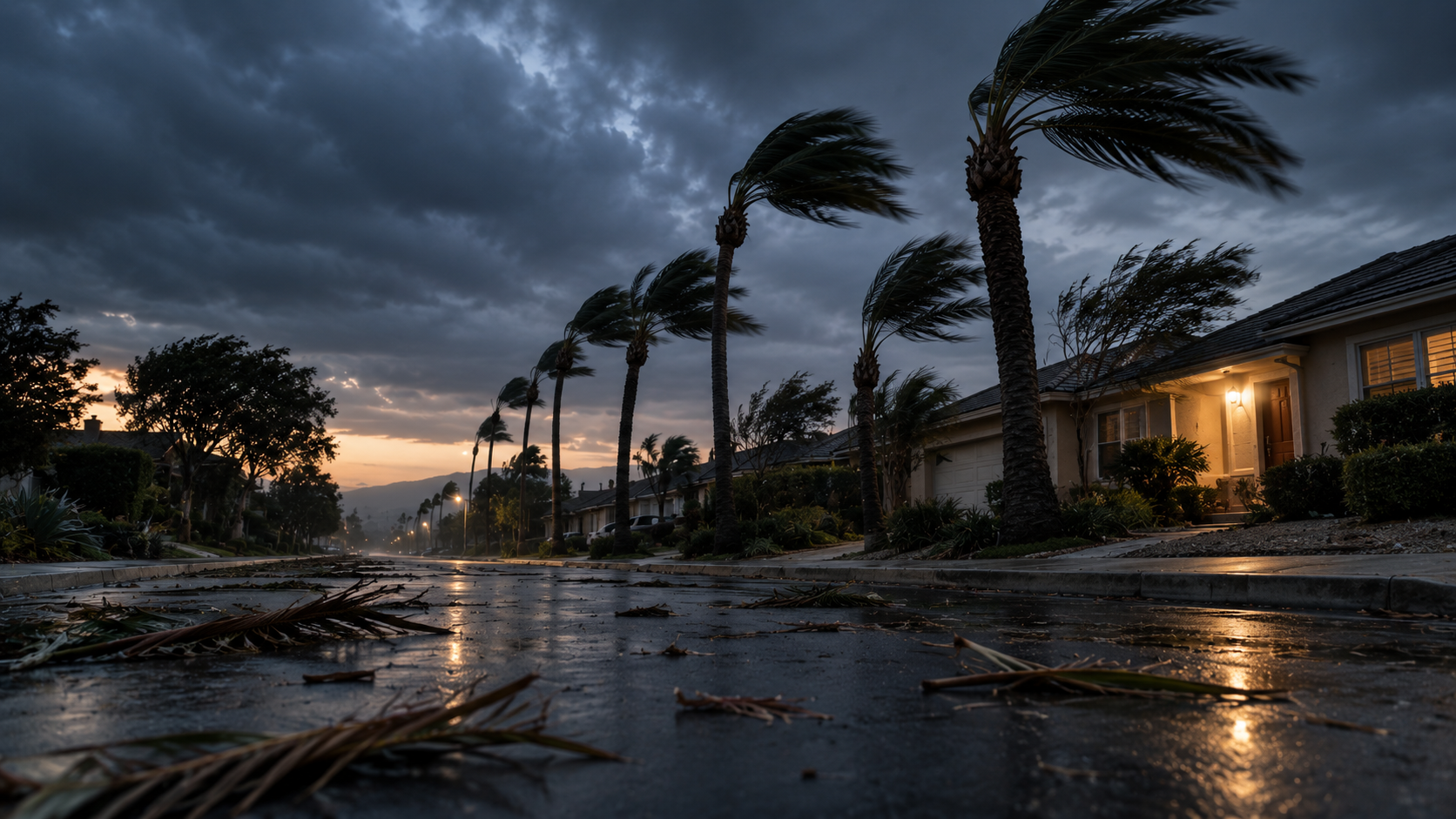
Southern California's storm profile is streaky. Santa Ana wind events push gusts through canyons and foothill neighborhoods strong enough to strip shingles, throw patio structures, and drop limbs on rooflines. Winters swing between dry years and stretches when saturated Pacific systems stack up for weeks, and the region's homes, built for sunshine, leak in ways their owners discover all at once.
Storm claims run into a specific carrier reflex: attributing the damage to the age of what broke rather than the force that broke it. A fifteen year old roof that loses a field of shingles in a documented wind event will be described as worn out, and the interior water that followed becomes a maintenance issue instead of a covered loss. The event gets erased from its own claim.
This article covers how these claims work, where they turn, and how to keep the storm in the story. Coverage always depends on the specific policy language and the facts of the loss.
Wind works on the envelope: lifted and creased shingles, torn underlayment, displaced tiles, peeled flashing, and failed ridge caps, plus the blunt trauma of airborne debris and falling branches. Fences, gates, patio covers, and detached structures take their own hits under the other structures coverage. Much of this damage is invisible from the ground, which is why storm losses get underdiscovered as often as underpaid.
Rain exploits what wind opens. Water follows a torn underlayment seam into the attic, tracks along framing, and appears as a ceiling stain two rooms away from the entry point. Wind driven rain also forces itself past intact but overwhelmed assemblies, window heads, stucco cracks, door thresholds, in volumes ordinary weather never tests. By the time damage shows inside, the path usually runs through several building layers that all belong in the scope.
Every roof on earth is aging, so a carrier can always point at wear, and the exclusion for deterioration gives the argument a policy hook. What the argument skips is that an aging component and a covered windstorm are not mutually exclusive. The legal question is what caused this damage, and under California's approach to mixed causes, coverage generally follows the predominant, efficient cause of the loss. A wind event that tears functioning shingles off a serviceable roof is a storm loss, whatever the roof's birthday.
When the money is large enough, carriers commission engineering reports, and the reports deserve the same scrutiny as the denial they support. Read for what the engineer actually inspected and when, which photographs the opinions rest on, and whether the conclusions address your documented wind event or generic aging. An opinion built on a single site visit weeks after tarping can be answered, with a policyholder retained inspection, with the contemporaneous photos, and with the weather data the report ignored. Reports feel authoritative. They are evidence, and evidence gets tested.
The evidence that decides it is concrete: the weather record for the date, the pattern of the damage, wind damage is directional and concentrated where deterioration is uniform and gradual, granule condition on displaced shingles, fresh breaks versus weathered edges on tile and wood, and the condition of the roof before the event, which inspection reports, sale documents, and dated photos establish. Carriers write age on files from the driveway. Rebuttals come from the roof.
The cheapest storm claim preparation happens in dry weather. A dated set of roof and exterior photographs each year, kept with the inspection report from the last service, is the pre loss condition file that dismantles a future age argument before it forms. Ten minutes with a phone camera every autumn converts the hardest evidence problem in storm claims, what the roof looked like before, into a solved one.
Storm and wind claims are commonly reduced by attributing damage to age or maintenance rather than the weather event. That call can determine what gets paid. Send the adjuster's report, the estimate, or the denial letter, and we review your policy alongside the insurer's reasoning. Nothing is owed upfront.
Get my free claim reviewTwo water labels decide a lot of Southern California storm money. Rain that enters through an opening the storm created, or is driven through the envelope by wind, is generally a covered water loss on a homeowners policy. Rising surface water, storm runoff pooling at grade, and mudflow belong to the separate world of flood insurance, excluded from the standard form. The same soaked floor can sit on either side of that line depending on how the water arrived.
Adjusters reach for the flood label in hillside and heavy rain scenarios because it ends the claim, and the label deserves scrutiny every time. Water staining that starts at the ceiling did not rise from the street. Entry at a wind damaged window head is not surface water. Establishing the pathway, with photos, moisture mapping, and the contractor's findings, keeps a covered wind driven rain loss from being quietly reclassified out of the policy.
Back to back storms raise an occurrence question with money attached. Damage from separate wind events is ordinarily separate losses with separate deductibles, while continuing intrusion from one unrepaired opening across a stormy stretch is one loss, and the framing affects both the deductible count and how the damage gets attributed. Keep the dates straight in your documentation, tie each finding to its event, and do not let a multi storm season get blurred into a single vague file that serves the carrier's version of the math.
Round out the storm claim with the smaller structures the wind actually hit. Fences, gates, patio covers, sheds, and pool equipment draw on the other structures coverage, typically a percentage of the dwelling limit, and screened or open structures sometimes carry their own carve outs worth reading. These items get left off claims constantly because each one feels minor, and a wind event that crossed the whole property deserves an estimate that did too.
Storm files get rebuilt around causation. The firm assembles the weather record, the damage pattern evidence, and the pre loss condition documents, then measures the carrier's age theory against them in writing. Partial payments that cover the roof but orphan the interior water path get itemized and challenged the same way.
Where the carrier holds its position, the dispute escalates with the record already built for it. The firm's practice is policyholder representation exclusively, which on storm claims means one alignment: the family whose house took the hit, against the characterization that pretends the weather never happened.
Past results do not guarantee a similar outcome. Every claim is different.
Age affects value, not existence of coverage. An old roof can still suffer a covered wind loss, and depreciation is the tool policies use for age, not blanket denial. Ask for the carrier's specific evidence that deterioration, rather than the documented wind event, caused this damage, and answer it with the roof findings and weather record.
Usually yours pays first, your policy covers the damage to your property regardless of whose soil the trunk stood in, and questions of the neighbor's responsibility arise mainly where their negligence about a known hazardous tree can be shown. Third party scenarios like this get a fuller treatment in a later article in this series.
Standard forms include debris removal for covered losses and commonly a capped allowance for tree removal in defined situations. The limits are modest and the definitions matter, so submit the cleanup invoices and let the policy language, not an adjuster's shorthand, set what qualifies.
No. Prompt notice provisions require reasonable diligence, not clairvoyance, and roof and attic damage is routinely discovered on the next rain or the next inspection. Report when found, document thoroughly, and date the discovery honestly, late discovered is a normal category of storm claim, not a defect.
The estimate, the denial or partial payment letter, and your documentation get read against the weather record and the policy, and you get a direct answer on whether the age theory survives. CaliClaims Law reviews property insurance claims for Southern California policyholders at no cost. One call. That's all.