
CaliClaims Law
one call. that's all
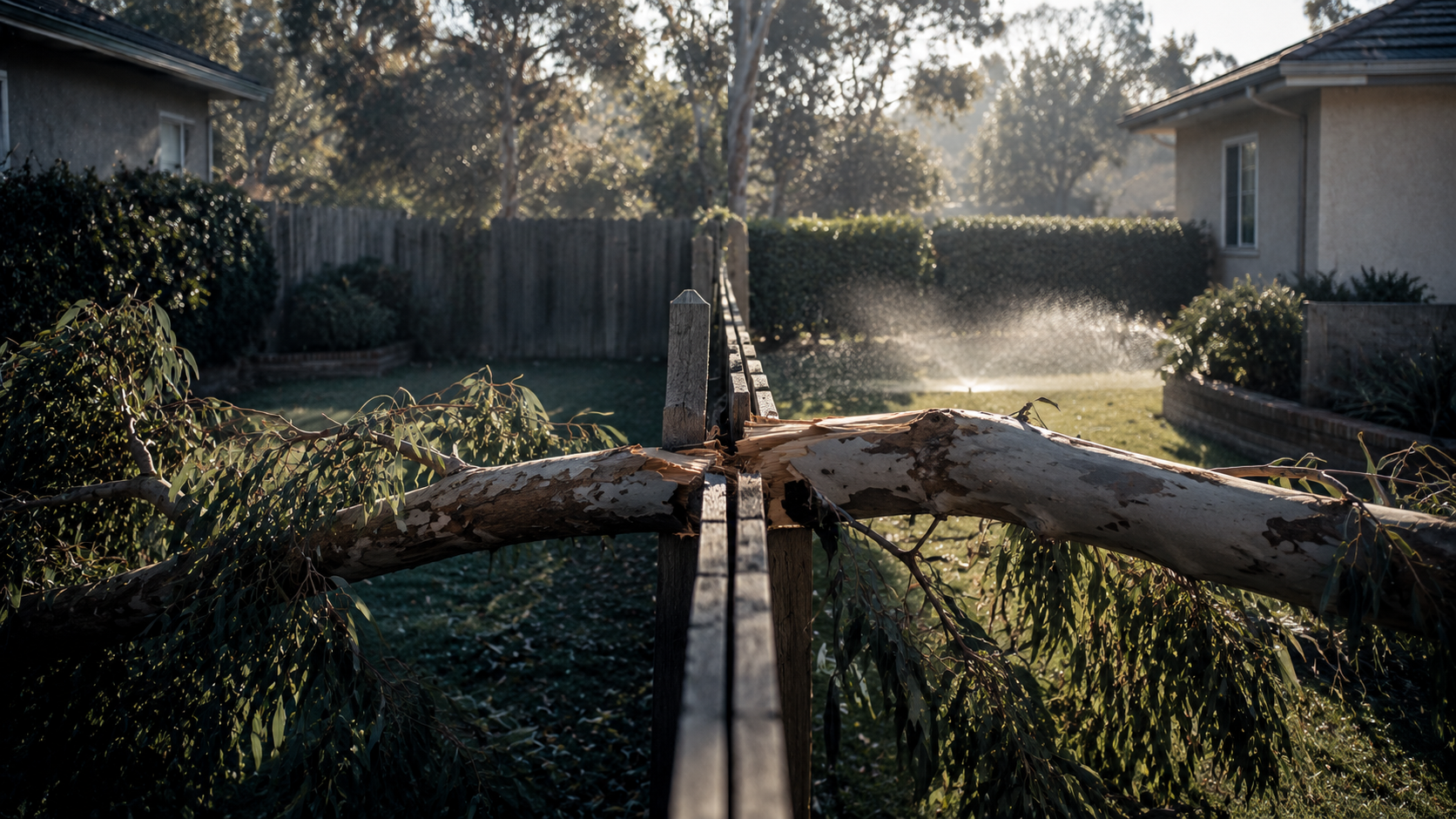
The damage is unmistakable, and so is the cause: the neighbor's dying pine finally came down across your roof, the contractor's crew cut a supply line, a car left the road and took out your fence and half the garage wall. Someone else did this. Which is exactly when the insurance picture, which seemed simple, splits in two.
There is your homeowners policy, which covers your property against covered perils without asking whose fault the peril was. And there is the responsible party's liability insurance, which owes you nothing by contract and pays only when the facts establish their insured's legal responsibility. Two payers, two sets of rules, two very different conversations, and the households that recover fully are usually the ones that run both lanes deliberately instead of picking one on instinct.
This article maps the two lanes and the scenarios where they matter most. Coverage always depends on the specific policy language and the facts of the loss.
Lane one is first party: your claim, on your policy, under the contract. Its virtues are speed and certainty, coverage does not wait for a fault investigation, and every protection this series describes, the handling regulations, the valuation rules, the appraisal clause, applies. Its costs are your deductible and, sometimes, the loss falling partly outside your coverages. When your carrier pays, it acquires subrogation rights, meaning it can pursue the responsible party's insurer to recover what it paid, and a successful subrogation commonly brings your deductible back with it.
Lane two is third party: your liability claim against the responsible person, answered in practice by their insurer. Its virtue is scope, a liability recovery is not bounded by your policy's limits and exclusions, and it owes you the deductible and uncovered losses lane one left behind. Its cost is proof: negligence or other legal responsibility must be established, the other carrier's duty runs to its own insured rather than to you, and the process moves at the speed of a fault investigation, which is to say slowly.
The lanes interact more than they compete. Filing with your own carrier does not surrender the liability claim; it funds the repairs while that claim matures, and your carrier's subrogation interest aligns it with your version of the facts. The coordination points are practical: keep both files supplied with the same evidence, route the uncovered losses and the deductible to the liability lane explicitly, and make sure any settlement or release in one lane is reviewed for what it does to the other before anything gets signed.
Whatever the claim type, the first step is the same. Send the denial letter, the estimate, or just the story. We read your policy, the insurer's position, and the gap between them, then tell you where you stand. There are no upfront fees, and fees come only out of a recovery.
Get my free claim reviewThe neighbor's tree is the archetype, and its rule surprises people: when a tree falls without warning in a storm, your own policy typically leads, and the neighbor's liability generally attaches when they knew or should have known the tree was hazardous, dead, diseased, previously flagged, and did nothing. The documentation that decides it is homeowner homework: photos of the decay, the arborist's note, the letter you sent last spring. The storm article in this series covers the wind side; the negligence side lives here.
Contractors bring liability closest to home, because the responsible party is someone you hired. Water lines cut, roofs left open to rain, fires started by trades, structural errors, all typically sit inside the contractor's commercial liability coverage, alongside license bond remedies and contract claims. The practical moves are early: written notice to the contractor, a demand on their carrier with the evidence attached, and care with any repair agreement that could read later as a release.
Vehicles into structures and water from the property next door round out the set. A driver's auto liability coverage answers for the fence and the garage wall, with your homeowners policy as the fast lane while it does. An upslope neighbor's failed irrigation or a renovation that redirected drainage raises liability for the water pushed onto your land, one of the rare paths by which water arriving at ground level connects to a responsible payer. In each scenario the two lane logic holds: your contract funds the repair, their liability answers for the balance.
Understand what the liability carrier is actually doing while it seems to do nothing. It owes its duties to its insured, not to you, so it investigates fault at its own pace, communicates strategically, and prices early settlement against what pressing further would cost. Offers arrive framed as full and final while the damage is still being discovered, and releases arrive drafted broadly. The counters are structural: a demand supported by documents rather than phone calls, damages established before numbers get discussed, and nothing signed until the scope of loss, including what repairs reveal, is genuinely known.
Shared living arrangements add a third document to the analysis. In condominiums and planned communities, damage crossing unit lines or arriving from common areas runs through the association's master policy and the governing documents as well as the two insurance lanes, and who insures the roof, the pipes in the walls, and the fence on the line is a question those documents answer before any adjuster does. When a neighbor's unit floods yours or an association owned tree lands on your patio, pull the governing documents alongside the policies, because the responsible payer is sometimes an entity nobody thought to notice.
Third party files start with lane design: what the homeowners policy will fund now, what the liability claim must capture, and what evidence of responsibility needs preserving this week rather than this year. The firm runs the first party claim with the full toolkit this series describes, while the liability lane gets built as a documented written demand instead of a series of phone calls to an adjuster who works for the other side.
Releases, settlements, and subrogation get coordinated so one lane's resolution never quietly forfeits the other's. The firm's alignment does not move: the property owner who absorbed the damage, on every file, in both lanes.
Past results do not guarantee a similar outcome. Every claim is different.
Because the contract pays on coverage while liability pays on proof, and proof takes time. Your carrier funds repairs now, then chases the responsible insurer through subrogation, often recovering your deductible in the process, while the liability lane pursues what the contract could not reach. Waiting on the at fault carrier alone means your rebuild runs on their investigation's schedule.
Rating practices vary by carrier and are regulated in California, and not for profit fault, subrogation recovery, and claim outcomes all figure into how a loss is coded. The honest answer is that pricing consequences are carrier specific and worth asking about directly, while the certain consequence of not claiming, absorbing a major repair yourself, is usually the larger number.
Generally no. You have no policy with that carrier, and its requests are asks rather than obligations. Communicate in writing, send a documented demand, and let any interview happen only if it serves your recovery, on advice. The recorded statements article in this series covers the whole distinction between their adjuster's requests and your own carrier's.
Goodwill is welcome and structure protects it. Get the scope and cost documented professionally, put any private arrangement in writing, and be careful about signing anything releasing claims before the full damage, including what surfaces during repairs, is known. Informal handshakes over major property damage have a way of ending both the payment and the friendship.
Yes, that dual mapping is the point: what your policy owes now, what the responsible party's carrier should answer for, and the sequence that protects both. Bring the evidence of what happened and any correspondence from either insurer. CaliClaims Law reviews property insurance claims for Southern California policyholders at no cost. One call. That's all.