
CaliClaims Law
one call. that's all
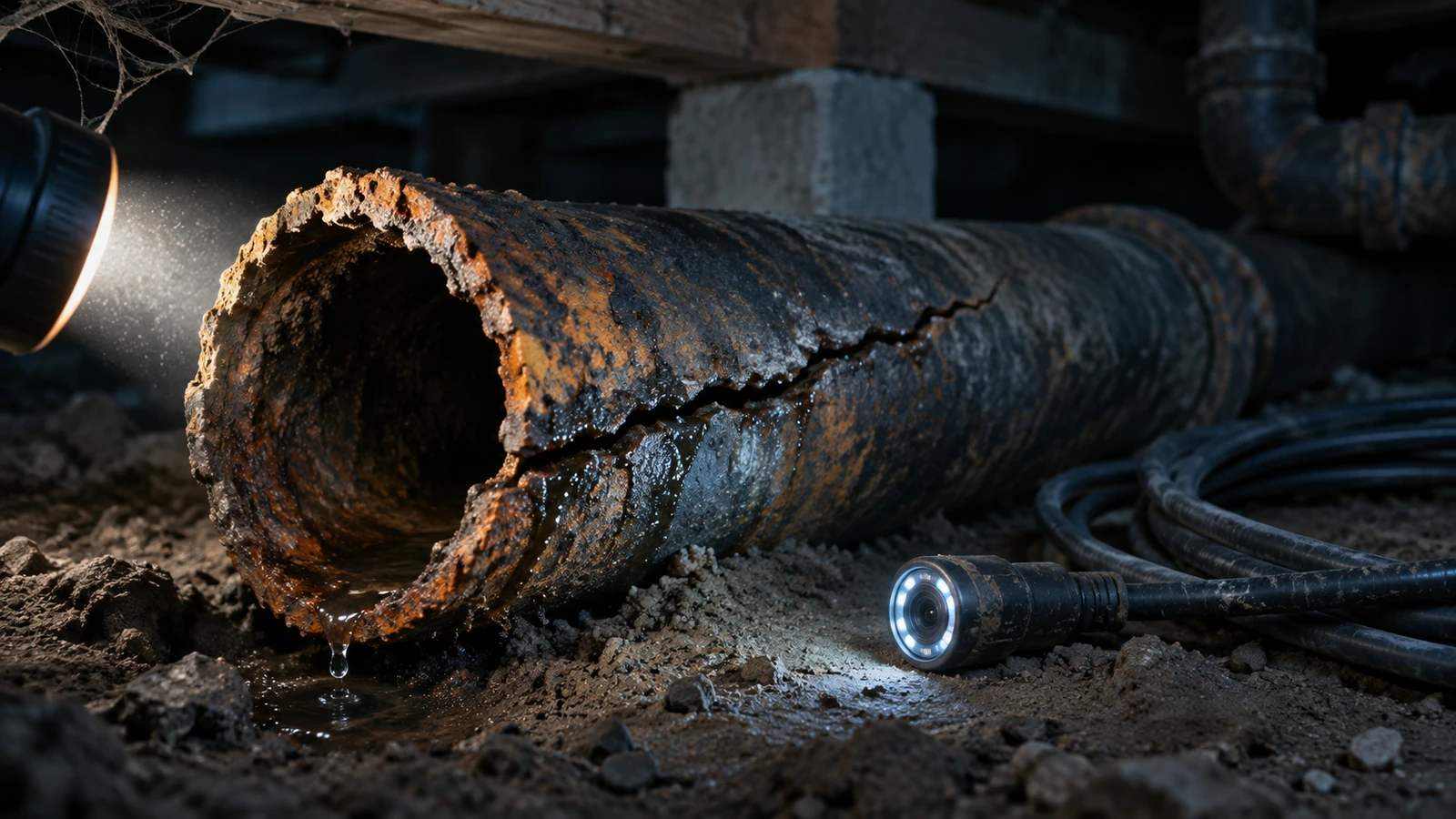
It usually starts small: a sewer odor that will not clear, a tub that drains slowly, a stain spreading across the ceiling below an upstairs bathroom, a baseboard that feels soft. The plumber runs a camera through the line and finds cast iron with a crack, a separated joint, or a hole worn through the bottom of the pipe. Then the carrier's letter arrives, citing corrosion and long-term seepage, and the cost of the repair and the damage around it lands back on the household.
If you're not sure what your house drains through, the clues are usually easy to find. Homes built before plastic drain pipe became common often still have their original cast iron, which was a standard material for residential drain and waste lines for decades. It is heavy, dark gray or rust-brown, and often visible at a cleanout, in a crawlspace, or on the plumber's video. The age of that pipe is typically the first fact a carrier's letter reaches for.
What makes these claims distinct is how a drain fails. A gravity drain leaks only when water runs through it, a little at a time, and that pattern sets up a fight over seepage that supply line claims rarely have in the same form. Coverage always depends on the specific policy language and the facts of the loss.
The pipe itself is generally not covered. Standard homeowners forms exclude loss caused by wear and tear, deterioration, rust, and corrosion, and a drain line that has deteriorated with age falls within that language, so replacing the cast iron is commonly the owner's expense.
The same forms often carve back the water. Many of them provide that when corrosion or deterioration causes water damage from a plumbing system that is not otherwise excluded, the policy covers the loss the water caused, including the cost of opening and restoring the parts of the house needed to repair the system, while still excluding the system itself. The way those access costs work under a slab is much the same for drains as it is for the supply lines involved in slab leak claims. What differs for a cast iron drain is how the water escaped, and that is where most of these disputes are decided. The policy's own exclusion wording, endorsements included, is what decides each part.
Drain lines are not under constant pressure. They carry water only when someone showers, flushes, runs the dishwasher, or does laundry. A cracked or rotted cast iron drain therefore leaks in pulses, dozens of small releases a day, rather than all at once.
That pattern fits neatly into a second exclusion. Many policies exclude damage from water that seeps or leaks repeatedly, or continuously, over weeks or longer. A denial that cites corrosion for the pipe and seepage for the water damage tries to reach every part of the loss with two sentences.
Seepage exclusions are not all written alike, though. Some forms include an exception for leakage that was hidden within walls or ceilings or beneath floors and unknown to everyone in the household. A cast iron drain under a slab or inside a wall is the textbook hidden leak, so the exact wording of the exclusion, and of any exception to it, matters more in a drain claim than in most water claims. The denial letter generally names the exclusion it relies on, and that text is the place where the analysis begins.
Wall stacks. In two-story homes, vertical cast iron stacks run through interior walls from upstairs bathrooms down to the main drain. A failing stack often shows up as a ceiling stain or a damp wall on the floor below, and the water travels inside the wall cavity before anyone sees it.
Crawlspace runs. On raised foundations, horizontal runs hang beneath the floor. Leaks there soak the soil, the subfloor, and the framing, and the evidence is easier to photograph than it is under a slab.
The drain under the slab. On slab foundations, the building drain runs beneath the concrete. These leaks are usually found by camera, and they are the hardest to date.
The sewer lateral. Past the foundation, the line becomes the lateral that carries waste to the public sewer. A failure in the yard raises different questions: whether the dwelling coverage reaches it at all, and whether a service line endorsement, where the policy has one, does.
Two features follow the water wherever it runs. Drain leakage is often contaminated, and industry water damage guidelines treat gray and black water differently from clean water, calling for porous materials such as drywall, insulation, and carpet to be removed and replaced rather than dried. Contaminated water also feeds growth, and the question of whether insurance covers the mold usually runs back through the same water event.
Water claims often turn on a single question: whether the loss happened suddenly or developed over time. That distinction can decide coverage, and it is frequently resolved against the policyholder with little explanation. Send us what you have. We read the policy language the insurer is relying on and tell you how it applies. Reviews cost nothing.
Get my free claim reviewFew cast iron failures have a single cause. Corrosion thins the pipe, and then roots push through a weakened joint, soil settles under the line, a heavy load cracks a brittle section, or cleaning work breaks through a wall that was already thin. The carrier's letter usually describes the loss by the corrosion. The plumber's findings may describe a different event that actually let the water out.
California resolves losses with mixed causes under its efficient proximate cause rule. In general terms, when covered and excluded causes both contribute, the courts look to the predominant cause, the one that set the others in motion, and a remote excluded cause in the background does not by itself defeat coverage for a loss whose driving cause was covered. How that rule applies to a particular drain failure is a fact question, which is why the camera video and the plumber's description of the failure matter so much.
California's fair claims rules, part of the California property insurance claim process, generally expect a carrier to investigate thoroughly and to state the basis for what it declines. Owners commonly respond to a single-label denial by asking in writing that the carrier address the pipe, the water damage, and the cause question separately.
The hardest cast iron files are the ones where the leak plainly ran for a while. A drain under a slab can leak for months unseen, and by the time an odor appears or a floor lifts, the carrier's seepage theory has some real evidence behind it.
Dating a drain leak takes different records than dating a supply leak. A burst supply line often leaves a spike on the water bill. A cracked drain releases water that has already passed through a fixture, so the bill rarely tells the story. The records that do are the ones in your own household: when flooring was installed or a room was renovated, when a plumber last cleared or scoped the line and what that visit found, when the first odor or slow drain was noticed, and when the first report went to the carrier. Each date narrows the window in which the leak could have been running, and together they answer the question a denied water damage claim letter usually raises: how long, and could anyone have known.
A cast iron file starts with the failure itself: where the line runs, what the camera shows, how the plumber describes the breach, and what the household's own records say about timing. That evidence is then read against the policy's corrosion and seepage exclusions, any hidden-leak exception, and any endorsement that reaches the lateral or drain backup.
Where the carrier has applied one exclusion to the whole loss, the response takes up each part on its own terms, with the evidence attached. CaliClaims Law represents policyholders only, never insurance companies, and handles property insurance claims across the seven Southern California counties. The claim review is free, and an honest read includes saying so when a denial holds.
Past results do not guarantee a similar outcome. Every claim is different.
Not always. The drain inside and beneath the home is part of the dwelling, while the lateral running through the yard to the public sewer sits outside the foundation, and policies treat it differently. Some policies offer a service line endorsement that reaches buried lines on the property. The declarations page and the endorsement list show whether one is in place.
It means the carrier believes water escaped repeatedly over weeks or longer, which many policies exclude. Whether the exclusion applies generally turns on its exact wording, whether the form has an exception for hidden leakage unknown to the household, and what the camera video and the plumber's findings show about how and when the drain failed.
Generally not. A backup is water or waste coming back up through the drains into the home, a peril many base policies exclude and some cover through a separate water backup endorsement. A leak through a cracked or rotted pipe wall is water escaping from the plumbing system itself, which falls under different policy language.
Often it is how the failure is found in the first place, and the video is among the most useful records the claim has. Keep the full video file, the inspection invoice, and the plumber's written findings. If the carrier wants to inspect the line before repairs, ask for that request in writing.
Yes. Bring the policy, the denial or estimate letter, the camera video, and the plumber's report, and the review separates what the carrier treated as excluded from what the policy may still reach. CaliClaims Law reviews property insurance claims for Southern California policyholders at no cost. One call. That's all.